
NASA has discovered possible signs of life from the past on Mars
To determine whether the planet ever had life, it will be essential that the samples collected by the Perseverance rover be brought to Earth and examined in detail.
:eitb-banner?$eitb-banner$&fmt=webp-alpha&qlt=80 "El rover Perseverance recurendo el cráter Jezero de Mars. Photo: EFE/NASA")
Perseverance rover studying the Jezero crater on Mars.

Since 2020, the Perseverance rover has been crossing the Martian crater Jezero in search of traces of ancient life, a study in which scientists have discovered strange mineral nodules whose chemical history suggests that they could have been formed into prebiotic chemical processes or microbes, both of which are mechanisms directly related to life.
NASA's rover collected samples last year in the Neretva Vallis area where, 3.8 billion years ago, a river deposited sediments in a lake in the current Jezero crater, where small nodules of clay minerals enriched with iron phosphate and iron sulfur have been found, along with compounds associated with organic carbon, which could be produced in the chemical reactions on which life is based.
In addition, the study has confirmed that these processes occurred after sediments were accumulated in the lake and under low temperature conditions, which makes these "unusual" samples a possible biosignature, although researchers have cautiously stressed that these findings may also be due to abiotic (non-biological) geological processes.
Conditions necessary for life
Life on Earth, in Antarctica, in the salt lake of Chott el Djeride in Tunisia, or in the mines of Riotinto in Spain, where the conditions of life are extreme, shows that life does not always develop under "comfortable" conditions, but through many chemical processes.
3.8 billion years ago, Mars and Earth were young and similar planets, both located in habitable areas. Although life developed on our planet, the fine atmosphere of Mars caused the loss of water and adequate conditions, turning the planet into a desert. However, for billions of years, the red planet had the presence and habitability of water.
"That's why we carefully selected the areas where Perseverance had to look for rocks that had been in contact with water," explains Felipe Gómez, a researcher at the Astrobiology Center, who collected samples in areas known as Bright Angel and Masonic Temple.
Gomez explains that the rover found "small spheres associated with reddish sludge," suggesting that they contained oxidized iron. Through the SHERLOC and PIXL instruments, they identified small phosphate nodules and sulfur, along with reduced iron and oxidized iron, the main elements for the chemical reactions on which life is based.
"We saw that nodules originated at low temperatures, which is essential because the birth of life is not compatible with high temperatures," the researcher said.
The challenge of bringing samples to Earth
The authors have called for caution: despite the high astrobiological potential of the samples, they can be the result of abiotic processes. "Only if we look at them in Earth's laboratories can we determine whether they are the result of a geological process or are related to microbial life," said UVA researcher Jose Antonio Manrique and member of the Mars 2020 scientific team.
That is why it is essential to bring samples to Earth. Currently, the US administration is considering two options: to retrieve samples with a landing machine and send them on a ship from the European Space Agency (ESA), or to return them through a manned mission from SpaceX. The decision will be taken by the end of 2026.
You might like

The Conqueror is back, presented by Julian Iantzi, Patxi Alonso and Lur Errekondo
This Monday begins on ETB2 a new edition of the adventure program with many innovations and surprises. In this edition presented by Julian Iantzi, Patxi Alonso and Lur Errekondo, they return to the Los Haitises jungle of the Dominican Republic.
The president has inaugurated IBM's quantum supercomputer in San Sebastian
The IBM Quantum System Two quantum supercomputer in San Sebastian is the first in Europe and the third in the world.

News: Quantum computer in San Sebastian, peace agreement for Gaza and committee of inquiry in the Navarre Parliament
A summary, in two words, of what will be news in the Present today.

What exactly is going on with Windows 10 this Tuesday?
We will resolve all questions about migration to Windows 11 and explain the free alternative options for using the Windows 10 operating system.
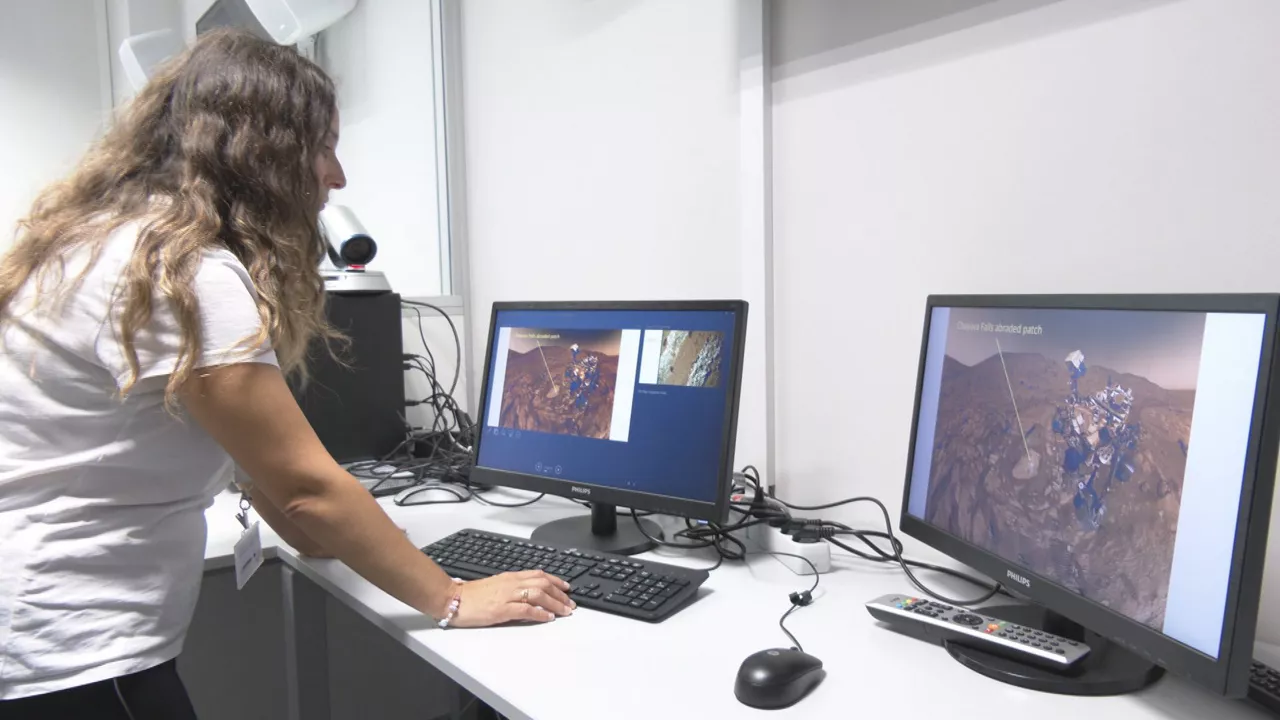
Perseverance rover analyzes samples of traces found in a crater on Mars
Of the two laboratories selected in the Spanish state to collect samples taken on Mars, one belongs to the UPV. From the analysis of these samples, this laboratory at the Leioa campus will be able to determine whether or not there has been life on Mars.