
The Basque Country has lifted the ban on holding livestock fairs, but will maintain measures to control nodular dermatosis
These measures will be in force until 15 January, and an extension or reduction of the deadline will be assessed depending on the epidemiological situation.


The Basque Government has decided to lift the ban on holding livestock fairs in force since last October. The measure was introduced last October following the detectionof nodular dermatosis of cattle in various communities of the Spanish State and in France. However, the Government will maintain a package of measures to reduce the risk of the disease entering and spreading in the Basque Country.
The Agriculture Adviser of the Basque Government, Amaia Barredo, has confirmed that the restriction that prevented the organisation of fairs will disappear, but that the different obligations affecting the movement and control of animals will continue. All these measures will be in force until 15 January, although the Basque Government will assess the extension or reduction of the deadline depending on the epidemiological situation.
Disinfection of vehicles and animals in all movements shall continue to be mandatory, unless the destination is the slaughterhouse.
The entry of animals from restricted areas, with the exception of those vaccinated against the disease, shall be prohibited. Furthermore, once the restricted areas meet the requirements laid down by European legislation for the movement of animals, the Basque Country may not be prevented from entering, but may require additional controls, surveillance and monitoring.
Similarly, for any animal that enters farms outside the Basque Country and is not directly destined for slaughterhouse, a veterinary surveillance check of 21 days shall be applied, which may be shortened or extended in accordance with the risk assessment carried out by the veterinarian responsible.
You might like

Solidarity has raised 361,665 euros in EITB Maratoia for healthy aging
One more year, hundreds of people and organizations have done their best to raise funds to research healthy aging. In total, throughout the day, EITB Maratoia has managed to add 361,665 euros, a figure that will continue to grow thanks to donations over the next few days.

BiomaGUNE warns that aspartame can be "harmful" to the heart and brain
Aspartame is an artificial sweetener that can help lose weight, but it's 200 times sweeter than sugar.

Spanish Government calls on the European Commission to authorise urgent vaccination in Hego Euskal Herria to combat nodule dermatosis
The aim of the Spanish Government is to inject all cattle into regions close to the border with the French State, namely the Basque Country, Navarra and Aragón, since in the last few hours new sources have appeared in the French State, also close to the border, with the aim of preventing the spread of the disease from reaching other communities.

Osakidetza broke records in November with 34 transplants at Cruces Hospital
The center has carried out 25 kidney transplants and 9 liver transplants in just one month, strengthening its national and international leadership in this field.

The Mossos d'Escaladra and the Civil Guard have searched the headquarters of the IRTA-CReSA laboratory for swine plague in Africa
They entered the building near Ground Zero this morning by court order. The area is under suspicion for a possible escape behind the African swine epidemic.

Mancisidor has been elected Ombudsman with the support of PNV, PSE-EE and PP, and opposition from EH Bildu
His predecessor, Manuel de Lezertua, formalized his resignation on 19 June, and since then Inés Ibáñez de Maeztu has been an active ombudsman.
Three people have been injured in an accident involving three vehicles and a bus on the BI-637 road in Erandio
The accident took place around 7.50 a.m. and forced the left and middle lanes to be cut, resulting in three kilometres of withholding.
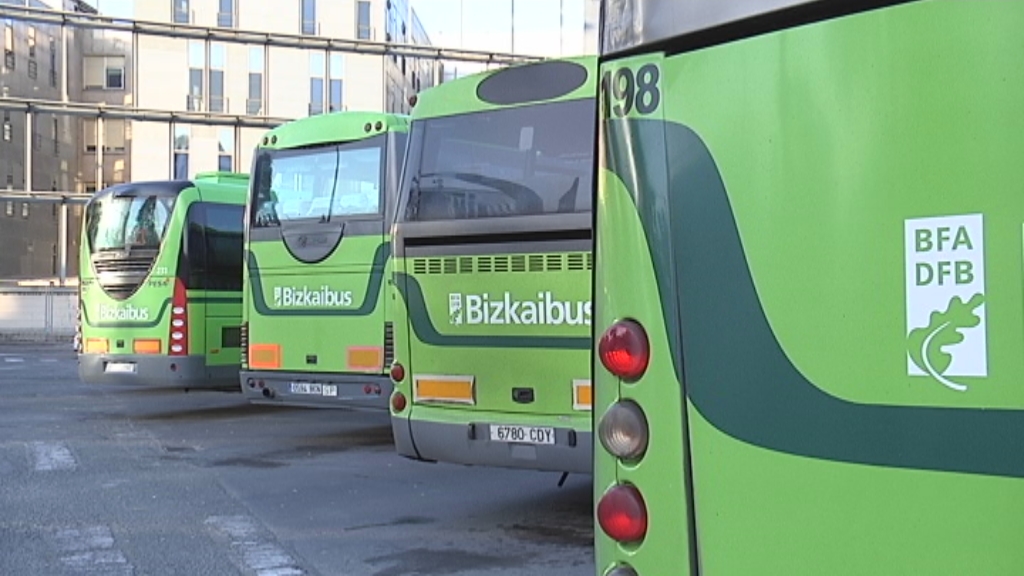
Bizkaibus will accept the Mugi card from Gipuzkoa from today
In this way, users of the three territories will be able to move with their usual card in Bizkaia through an integrated and homogeneous payment system.

News: EITB Maratoia, Talgo returns to the Basque Country and economic forecast for 2026
A summary, in two words, of what will be news in the Present today.

Peasant clothes on loan: "Families come mostly without a net."
The Orioko Herri Ikastola has organized for the second year in a row a plan to borrow peasant clothing as part of the "Light and Influence" initiative, which aims to reuse clothing and help families without a net in the village.